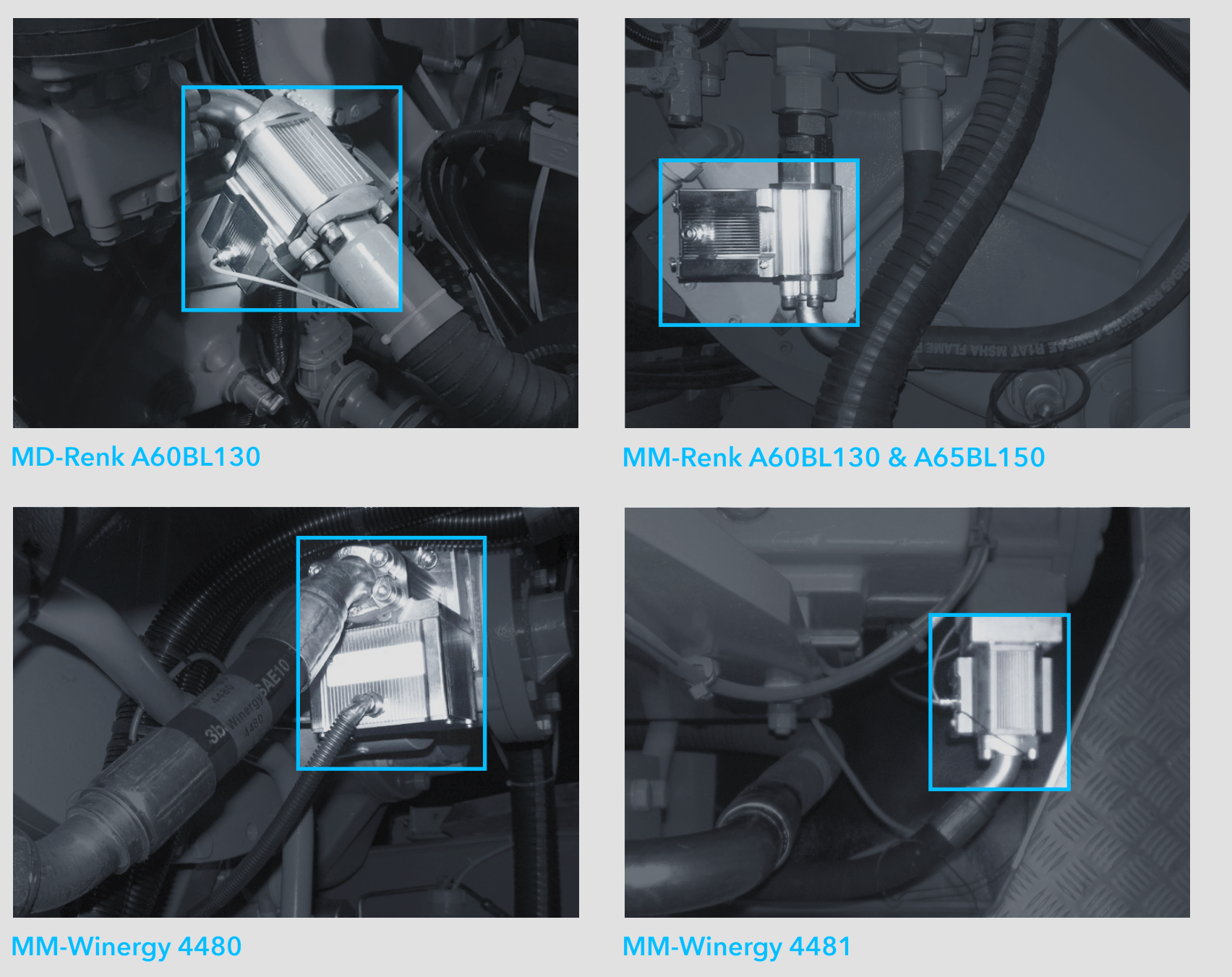
Did you know that all Senvion MM82 and MM92s were fitted with MetalSCAN MS3110EE as standard when they left the factory? This means that your Senvion wind turbines have gearbox CMS as standard. This can be accessed through the ReGuard SCADA system and can be used for predictive maintenance. If you are utilising an ISP or OEM for O&M it is possible to split the data so that you can keep an eye on the data without interrupting the feed to your maintenance provider.
Forking or daisy chaining the output
The main requirement for forking the Pulse output is to check that the output is greater than ≥1kΩ. Each output essentially acts as a new resistor wired in parallel so their cumuilative resistance would be calculated as follows:
1/Rt = 1/R1 + 1/R2
As long as RT is ≥1kΩ there should be no issue with forking the output. For example if you have SKF CMS (other vibration CMS brands are available) installed there would be no issue with impedence.
If it is not possible to calculate load impedence of the output systems from spec sheets you can use a signal isolator such as a FC-ISO-C from AutomationDirect.
Cable requirements
MS3110EE cables must be 24AWG stranded, shielded that complies with standards applicable to the location of installation. The signal can be forked from whichever terminal along the existing Pulse signal path that works best for the application.
Examples
Example 1: Add a new cable directly from the MS3110EE terminal strip.
Terminate a second wire to the PULSE+ termainal under the lid of the MS3110EE sensor. Connect the other end of this wire to the new output system as applicable. E.g. if a ground voltage reference is required, that could be taken from “PGND” terminal.

Example 2: Find another location along the Pulse signal path from which to fork the output
How to implement: trace the wire from the PULSE+ terminal of the sensor to the electrical cabinet/existing output system, add a new wire/cable from one of the terminals along this path and connect it to the new output systems as applicable (e.f. if a ground voltage reference is required, that could be taken from a terminal connected to the sensors “PGND”. This has the added benefit that less cable is required.
Can I replace my sensor?
The MS3110EE sensor is now obsolete but can be easily upgraded to the MS3510 series with the addition of a cable. This unlocks the ability to bin particles by size and classify into Fe and non-Fe.
For more information about Gastops MS3110EE sensor, integration and upgrade options contact us.


Leave a comment