Enercon Control Philosophy
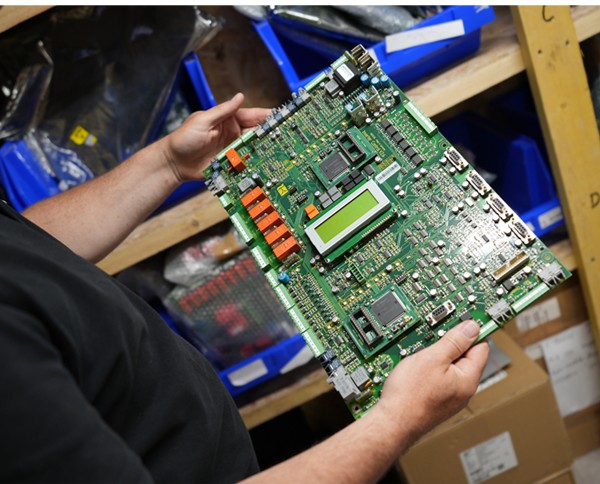
There are many PCBs within Enercon turbines that perform control functions. Rather than conventional controlled WTGs such as GE or Senvion that have a top and bottom controller and pitch system, the Enercon control architecture is more devolved. Each converter cabinet has its own control system providing redundancy in the event of failure. The pitch box houses everything needed to power and control the pitch system. The excitation cabinet for the generator does the same. This is a manufacturer who is more comfortable with electronics than mechanical parts, and this is reflected in the make-up of their service technicians. There are no gearbox or pitch hydraulics to be seen.

Wind turbine control function is dissipated across dozens of boards through the Enercon wind turbine
There are two meanings of Enercon control though. One is performative wind turbine functions, and another is OEM’s dominion over its offspring. Enercon protect their manufacturing both through preference of in-house techniques and having their factory located in an isolated part of Germany away from the other hubs for wind manufacturing. By only choosing to sub-contract specialist components such as encoders and slip rings under exclusivity agreements this gives Enercon the ability to control the parts pricing and get away with charging a premium. For control of service there are sometimes contractual restrictions on owners visiting their own wind turbines, and access to controllers is protected with service codes and daily codes which are released from Germany to keep operators out.

Controller retrofit allows access to owners and independent service providers (ISPs)
Challenges with this philosophy
If the owner wants to change O&M strategy at the end of their EPK contract, data access is always the best place to start. Whether pursuing an independent service (ISP) contract or in-house maintenance, turbine control and access is key to maintaining availability and managing vulnerabilities. This can be negotiated with Enercon directly but results with this approach are mixed. One of the main vulnerabilities is software and firmware compatibility. Once your Enercon contract is finished, you will have to coordinate your own software updates which can result in a mismatch of compatibilities between neighbouring components. This needs to be managed, both in new spare parts procurement and from an asset register perspective. Software updates are available to purchase from Enercon but these aren’t always timely or inexpensive.
Why change O&M strategy?
There are many drivers for this, the main ones are usually money or service quality. Can the owner achieve higher availability with a lower O&M cost? As wind turbines approach the 20-year design life during operation OEMs want to renegotiate a higher price, more carve outs for major components or availability or they may not want to renew altogether. As operators look to life extend to year 25 and beyond, they may need to find a new O&M provider.
Basic Access
For basic service, remote reset and control basic Enercon access is obtainable in the aftermarket at a low price (contact us). Enercon access can be obtained through minor hardware installation whilst leaving Enercon components in situ. This allows key information such as turbine status, output, pitch, production and alarms to be viewed and accessed remotely. Control of main switch, start/stop, resets, comms and maintenance modes can be toggled. This solution is available for WTG models E30, E33, E40, E33, E53, E66, E70, and E82. From here you can craft a basic SCADA system, using a second level provider. For more information on features and pricing contact us.

Basic Enercon Access hardware and interface
Full WTG Access
For operators looking to transition to self-perform O&M controller retrofit provides you everything that you need to gain access and independence without the vulnerability to OEM intervention. There is no more reliance on the OEM for service codes, SCADA, support or permissions to enable best practice operations. The controller replacement requires replacement of key PCBs within the control system of Enercon turbines and is currently only available on the Enercon E70 and E82 2.0 and 2.3MW. The operator gains the ability to reset alarms, change parameters and interpret snapshot logs in high resolution either side of a failure event. User interface is drastically improved from a text-based menu cycling through impossibly long German words to an intuitive touch screen.
Depending on your turbine type, full controller retrofit may be a good option for eliminating your reliance on Enercon. For this PCBs are changing in almost every cabinet, but at the end of the process you have access to everything in the system, parts independence, no need for Enercon service codes or back doors: and the ability to change parameters, achieve grid compliance and troubleshooting become intuitive rather than an exercise in constraint.

Controller retrofit allows you to reset alarms, set parameters, check snapshot and service logs and much more.
Cash Rules Everything Around Me
It is always easier to do nothing. At least in the UK, the price of power combined with generous ROCs means that wind remains profitable even with full-scope service contracts and there is no need to look at costs. This will not always be the case. Subsidies expire and OEMs walk away or carve out contracts on from aging sites as risk increases and legacy support falls away. When this happens, you have no leverage on profitability. You cannot increase the strength of the wind: you can only change your PPA and your OPEX contracts. If you could influence your availability, you would have already done it by now, right?
When you need to run from the lion, it’s better to have your trainers on already
In addition to reduction in O&M costs through contracts and spares, there are other opportunities to improve revenue and increase value. Ancillary services are achievable through Power Park Controllers (PPC), co-location of Battery Storage (BESS). By having accessible and programmable controllers positioned at all of your connection and generation points this allows automation of curtailment and avoidance of negative power prices. Wind generation availability increases through faster alarm response, greater remote access, fewer restrictions and power curve improvements can also see uplifts of 2.3% depending on the site. Controller retrofit can assure WTG Life extension through continuation of part supply, mitigation of loads and smoother pitching. It can also improve second hand turbine value, the new owner having the revitalised hardware and the ability to choose their O&M provider from day one of the WTG’s new life.
High contributors to downtime such as converter component failure due to humidity can be improved such as extension of heating systems during grid outages. This upgrade sustains heating operation as the turbine’s electronics temperature and humidity drops, preventing condensation build-up on electrical components. Once you have access to the controllers, there are fewer limitations on the improvements that can be made to reliability.

Converter cabinets can be unreliable when left off for long periods of standstill. Through control modifications you can improve reliability and reduce failure rates and downtime.
Conclusion
If you want to drive meaningful change on your wind farm then you need control of your this cannot be done without controller access. There are two options depending on your budget and desired amount of control but these will enable you to begin to manipulate your own turbines for the betterment of performance or the reduction of costs.
For more information please contact us.


Leave a comment